A linear model that outperformed deep-learning baselines on new people.
What if the EEG-to-fMRI bottleneck was aligning individuals, rather than finding a larger neural network? CABLE tested that question with subject-specific normalization and a shared linear model.
Align the subject, then make the prediction.
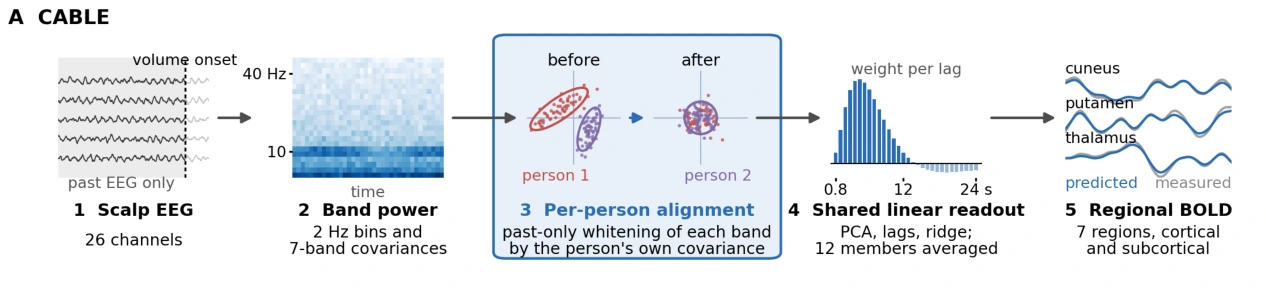
Each EEG recording is whitened using its own running, past-only covariance. A regularized linear readout then maps those aligned signals to regional BOLD responses. The method uses no labeled fMRI calibration for a new person.
Alignment
Reduce subject-specific sensor differences using earlier EEG observations.
Linear model
Read out regional brain signals with lags and ridge regression.
Practical efficiency
Train in CPU minutes on the tested datasets rather than requiring GPU-hour runs.
New people, and a new recording site.
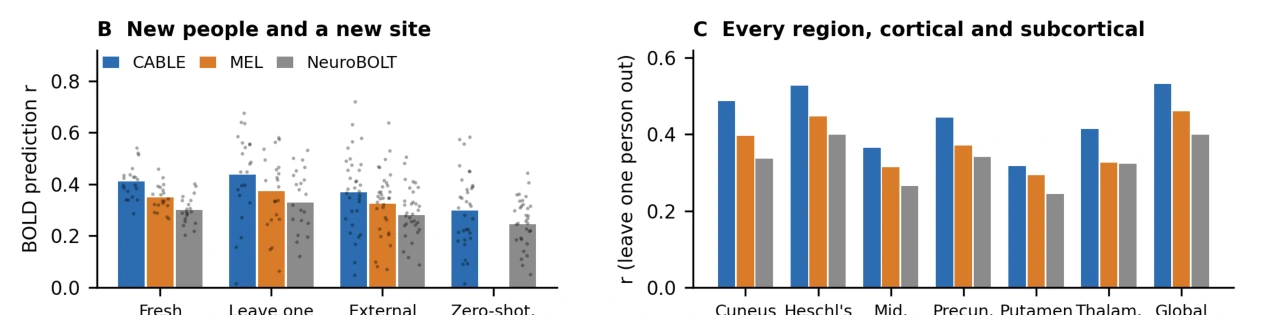
The main comparison uses 22 people with identical subject-disjoint evaluation splits across CABLE, MEL, and NeuroBOLT. The manuscript reports r = 0.41 for CABLE, r = 0.35 for MEL, and r = 0.30 for NeuroBOLT. An independent dataset of 33 adults provides an additional external-site test.
The alignment step did most of the work.
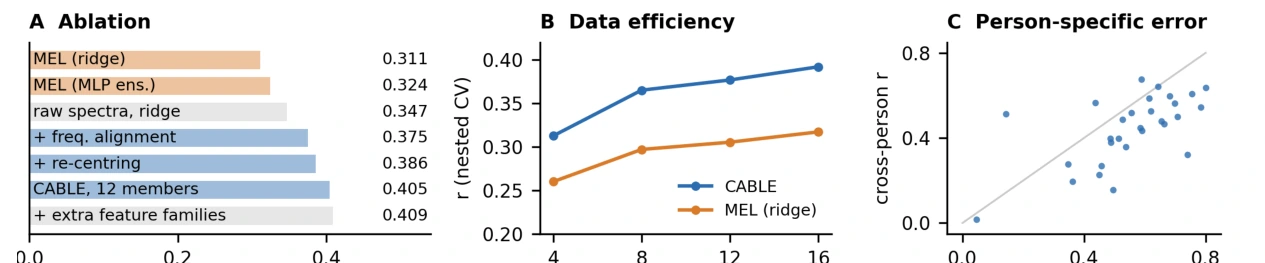
The ablation study contrasts raw spectral features, different alignment stages, the final ensemble, and larger feature families. More nonlinear capacity added little in these tests. It is a reminder that sometimes the useful insight is a better representation of the data.