NeuroAI, computational biology, and questions I wanted to test.
My research has involved original models, new representations, and tools for understanding biological data. I like moving between a difficult technical question and something another person could eventually use.
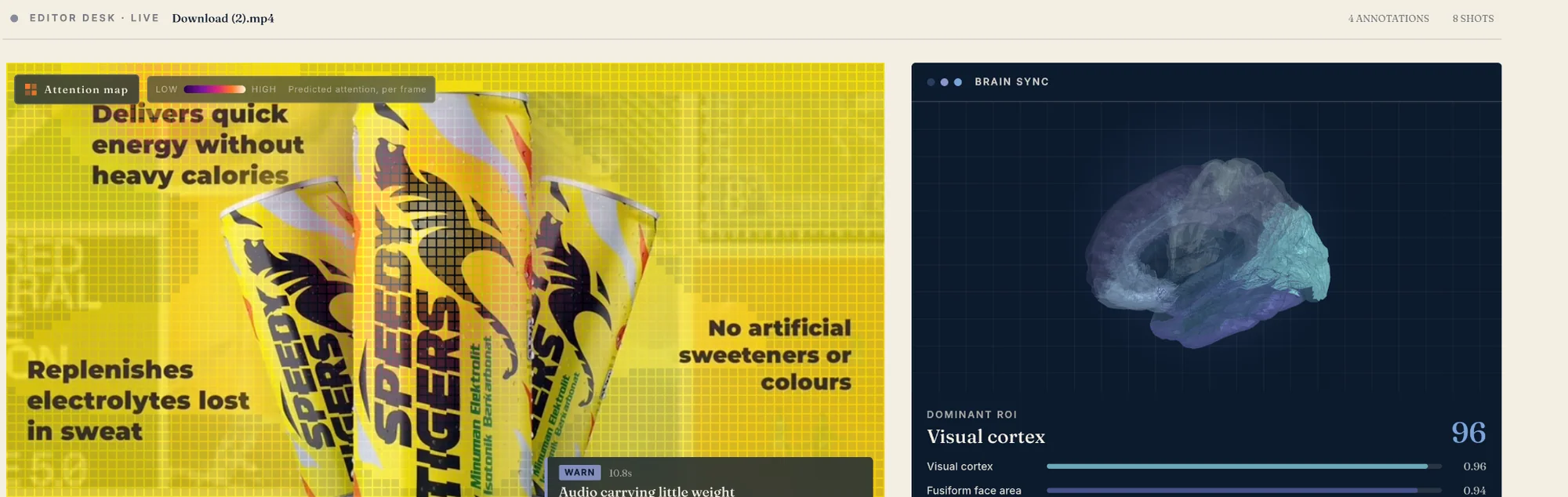
As the first neuroscience researcher at Presonance, I've investigated how the same film is represented across different sensory histories. In our research, contextual language-model features beat static embeddings across all five study groups, with 27 of 40 comparisons surviving FDR correction. I brought those insights into our team's evaluation and model-iteration work, including a team-reported internal comparison of 0.46 for Presonance versus 0.37 for Meta's TRIBE v2. That is an internal result pending full protocol disclosure.
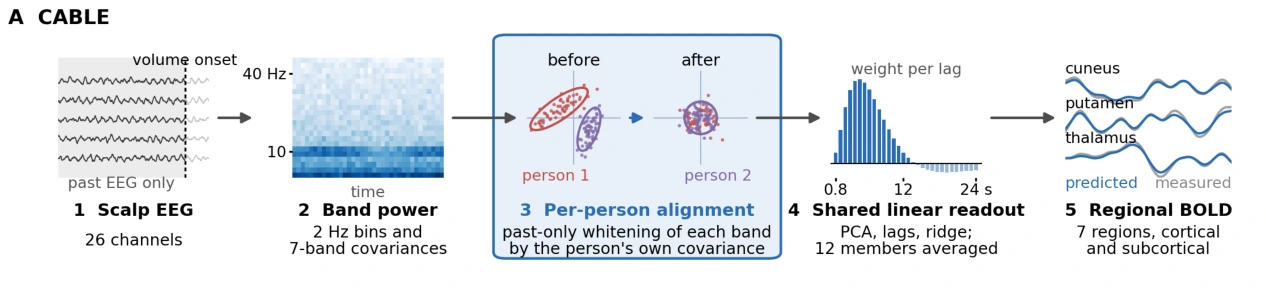
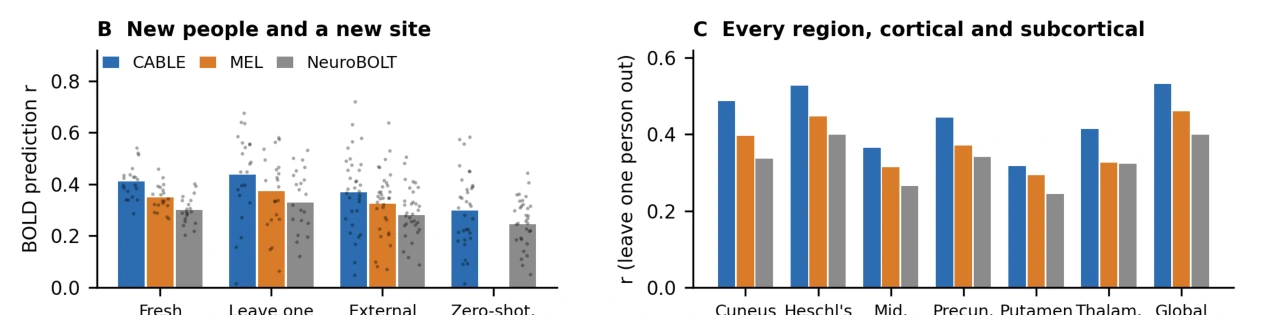
CABLE aligns EEG within each new subject and uses a shared linear readout to predict regional fMRI activity. Our submitted study reports better out-of-subject results than the evaluated deep-learning baselines and generalization to an external dataset.
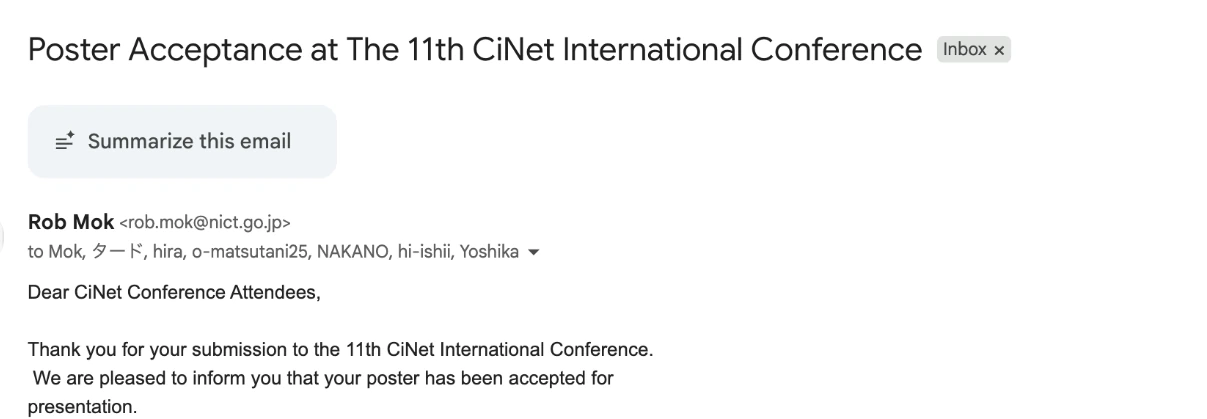
Two publications at NeurIPS 2026 workshop events, first-author NeuroAI work, an accepted presentation at the 11th CiNet International Conference, youngest presenter at Stanford CCRTP, a UC COSMOS symposium, a first-author RCC Research Journal article, and a CoSyNE submission. Open an image for the underlying record. The NeurIPS publications are workshop-track research, not main-conference papers.
Published · NeurIPS 2026 workshop
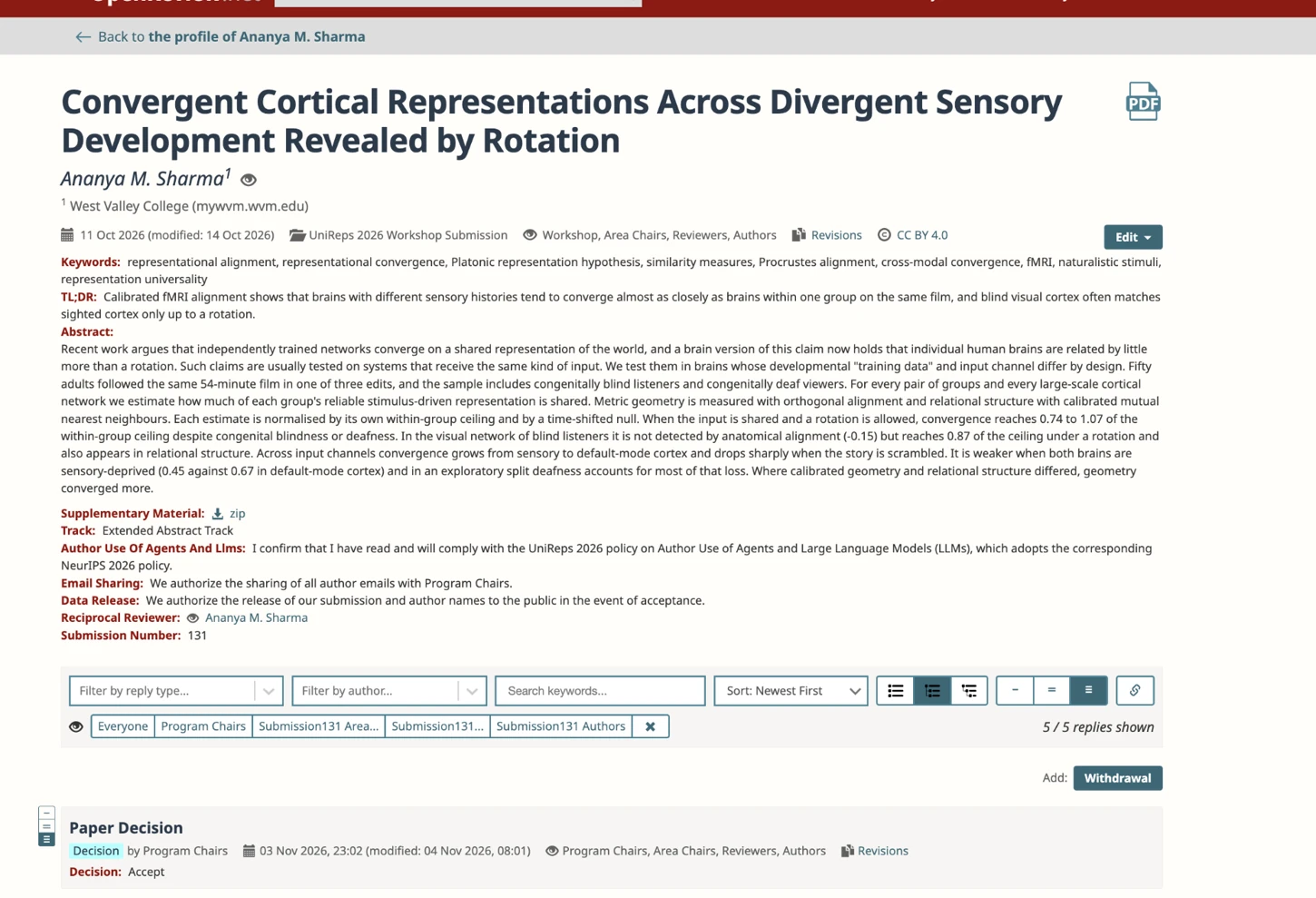
Convergent Cortical Representations Across Divergent Sensory Development Revealed by Rotation
First author (sole author). When comparing blind and sighted listeners, rotational alignment recovered visual-cortex convergence at 0.87 of the within-group ceiling, versus −0.15 under anatomical alignment. The result suggests shared representations can be organized differently.
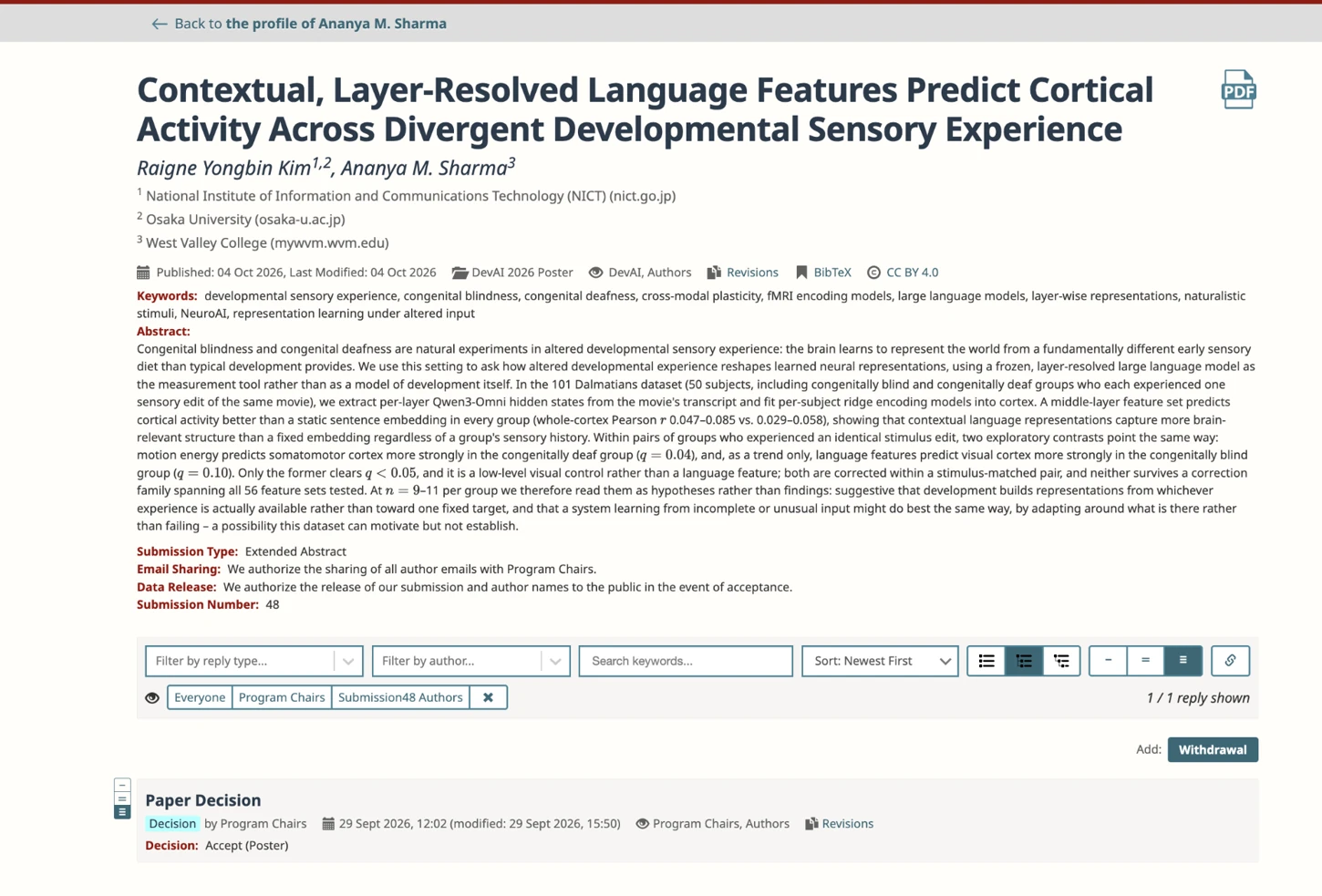
Contextual, Layer-Resolved Language Features Predict Cortical Activity Across Divergent Developmental Sensory Experience
Coauthor. Across five groups, contextual Qwen features predicted cortical activity better than a static sentence embedding; 27 of 40 group-by-network comparisons survived the paper’s FDR correction. Sensory-group contrasts remain small-sample findings.
Narrative Surprise Signals Cortical Reorganization Following Congenital Sensory Loss
First-author accepted conference research. Analyzed naturalistic fMRI responses to narrative surprise across congenital sensory loss, finding preliminary network-level differences that require correction across the full network sweep.
Accepted · Stanford CCRTP · Youngest presenter
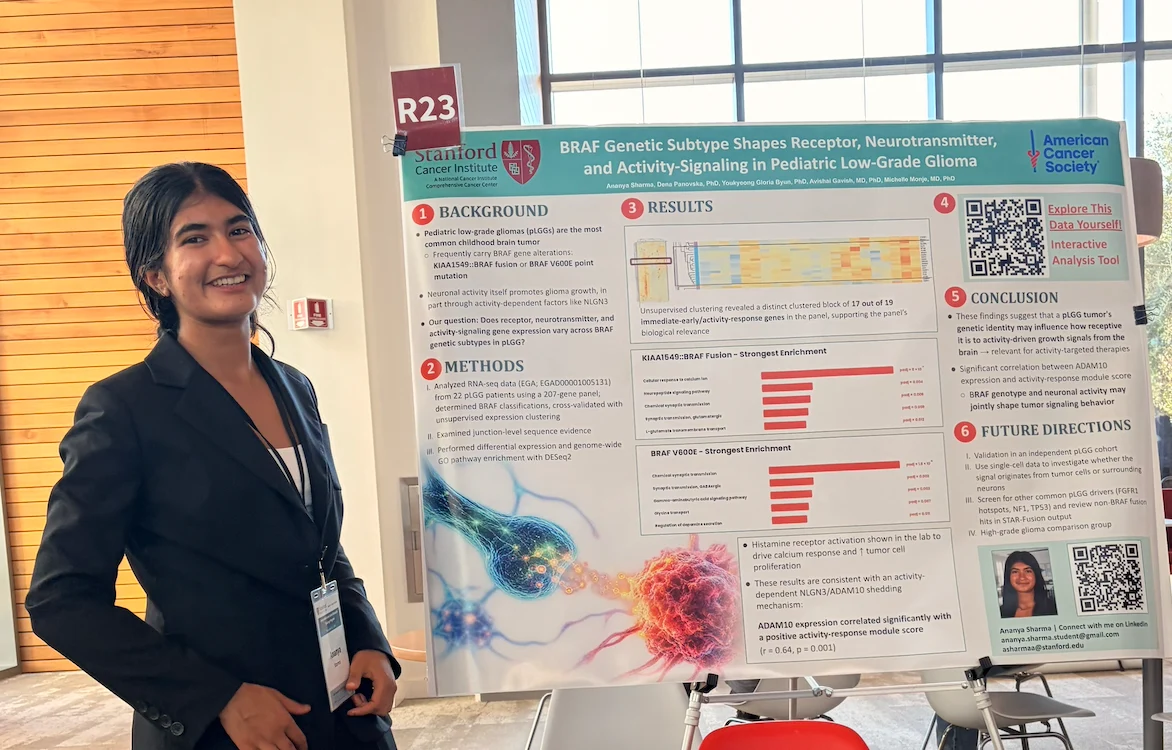
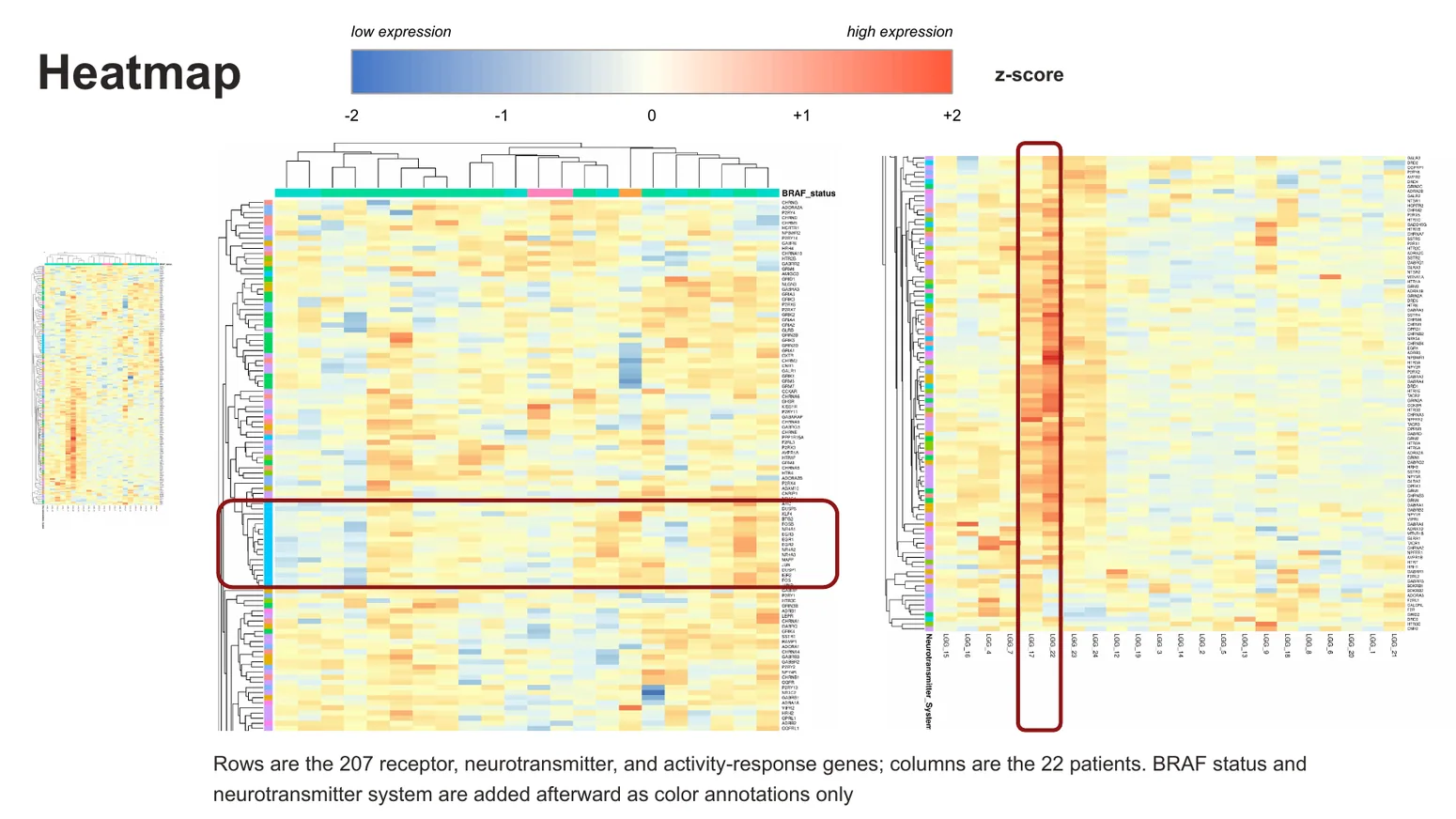
BRAF Genetic Subtype Shapes Receptor, Neurotransmitter, and Activity-Signaling in Pediatric Low-Grade Glioma
Presented computational findings from RNA-seq across a pediatric brain-cancer cohort.
Submitted · CoSyNE 2027
CABLE: A Linear Model That Outperforms State-of-the-Art EEG-to-fMRI Models on New Subjects
Generalization across subjects and external-site data. Current record is a submission, with no acceptance claim.
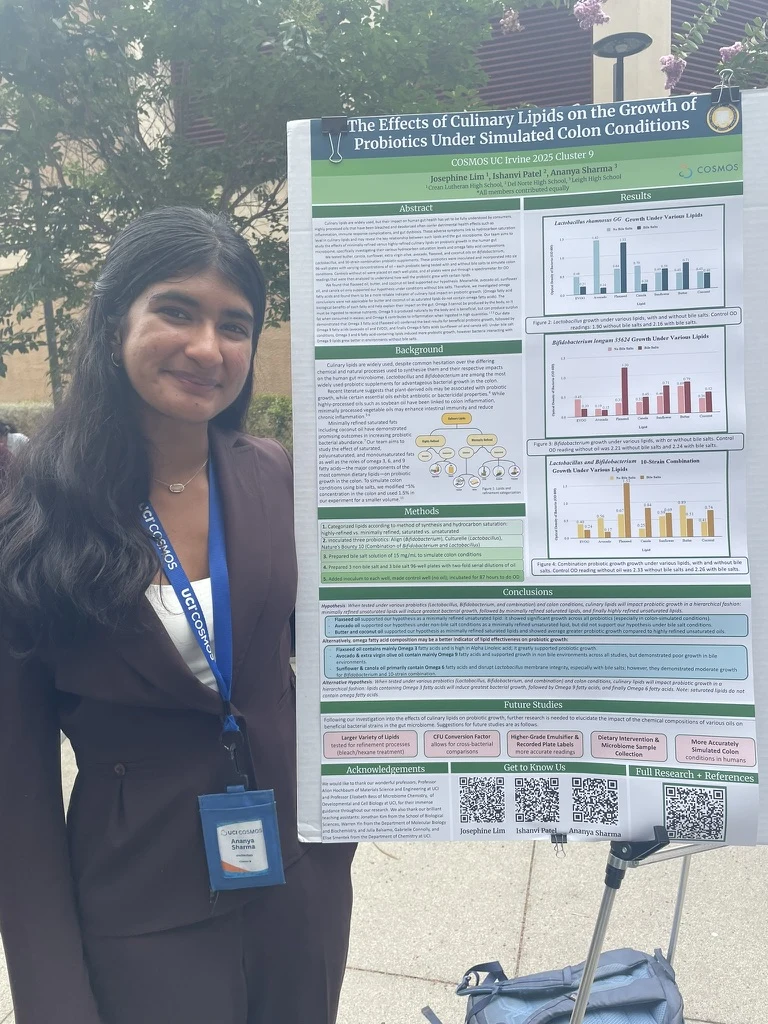
Probiotic growth, lipid conditions, and MATLAB modeling
Co-first-author research poster investigating microbial growth and metabolic responses.
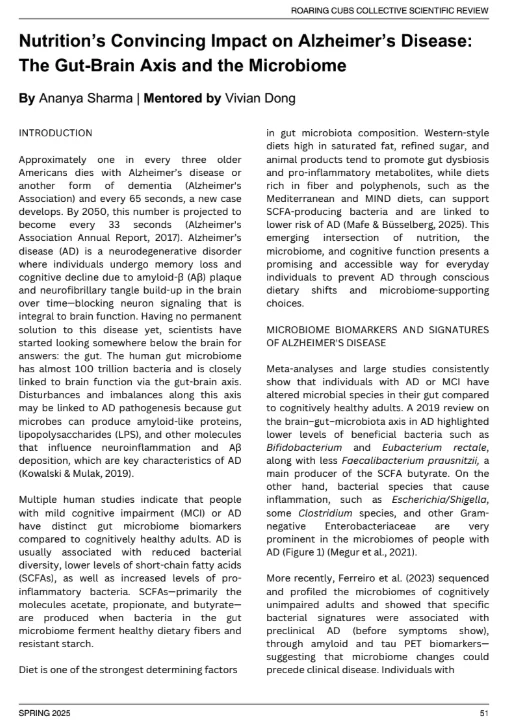
Published · RCC Research Journal · First author
Nutrition's Convincing Impact on Alzheimer's Disease: The Gut-Brain Axis and the Microbiome
My published literature review connects microbial metabolites, inflammation, and Alzheimer’s disease through the gut–brain axis. It synthesizes existing evidence rather than claiming a new clinical result.
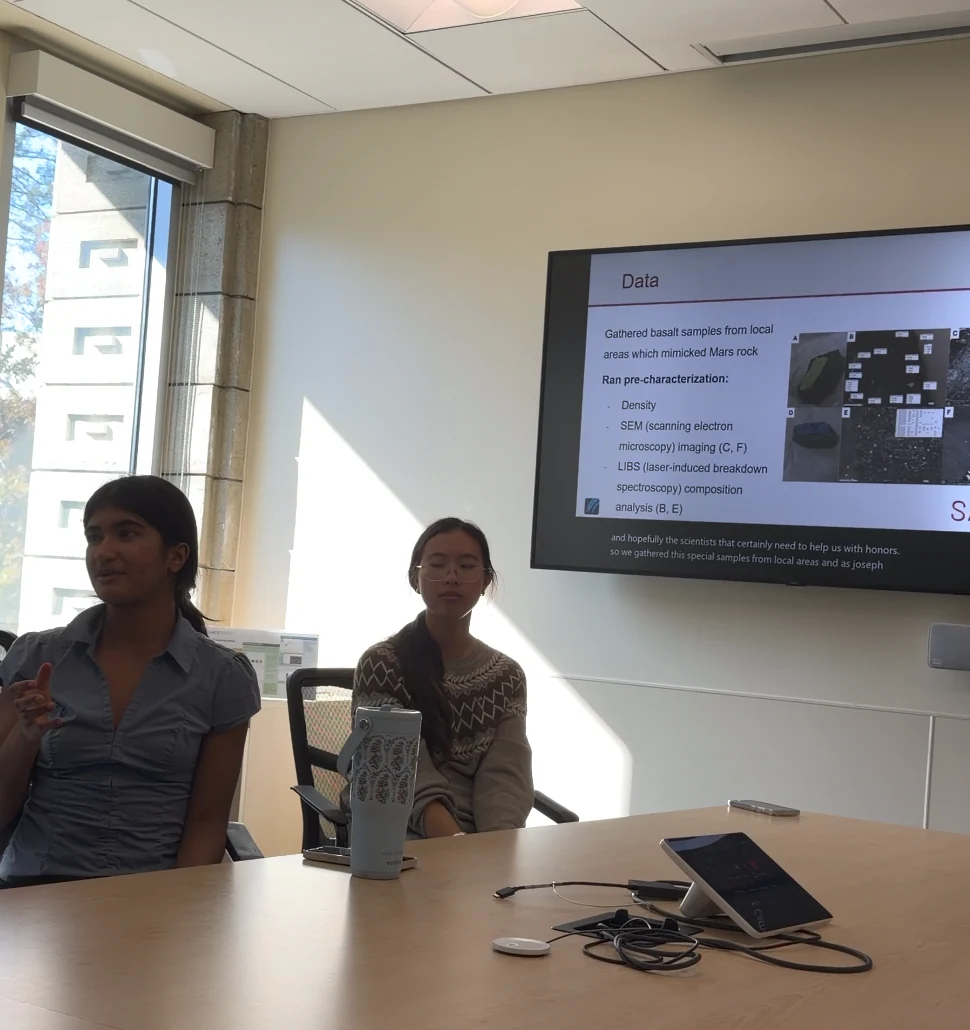
Presented · SLAC National Accelerator Laboratory
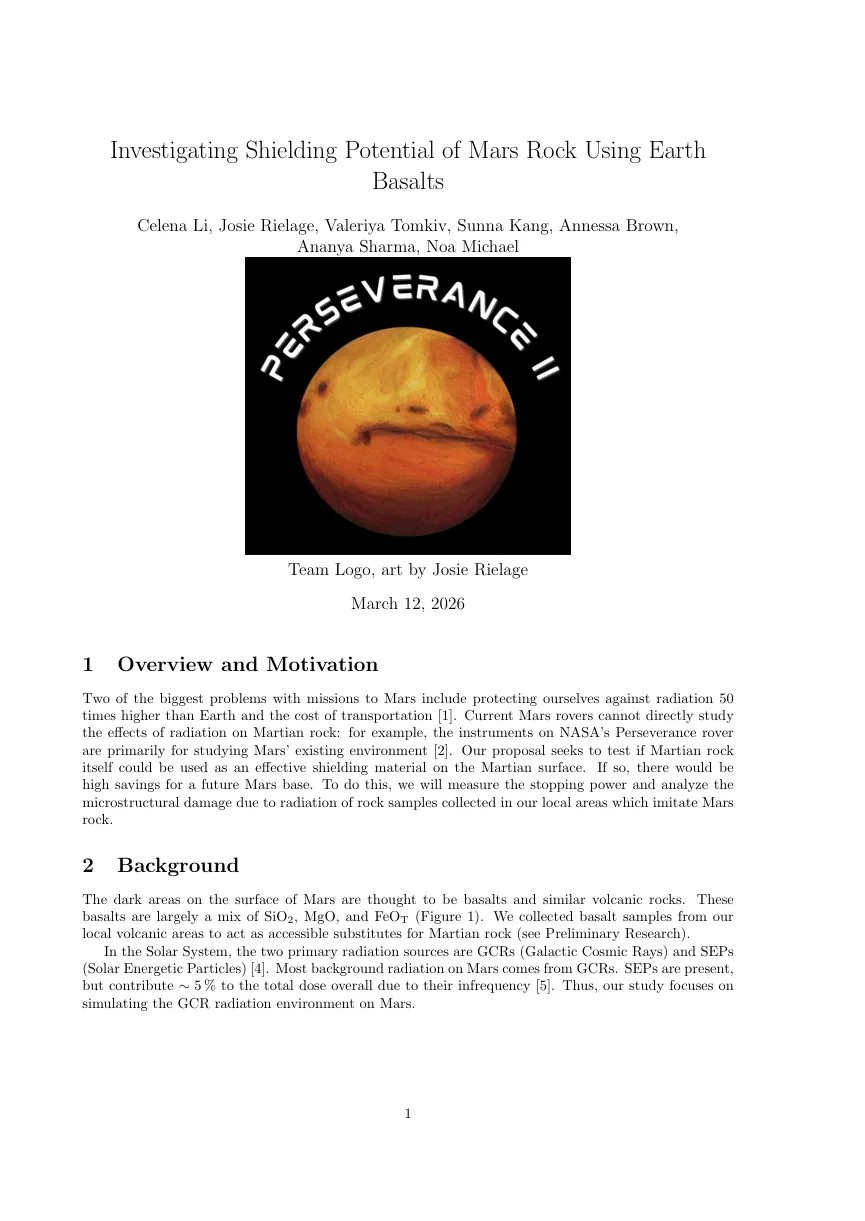
Mars basalt shielding research presented to national-lab scientists
Presented our team's Mars-radiation research proposal to SLAC scientists. The Beamline for Schools outreach proposal earned top-15 international recognition among 700+ entries.
Computational discoveries in pediatric brain cancer.
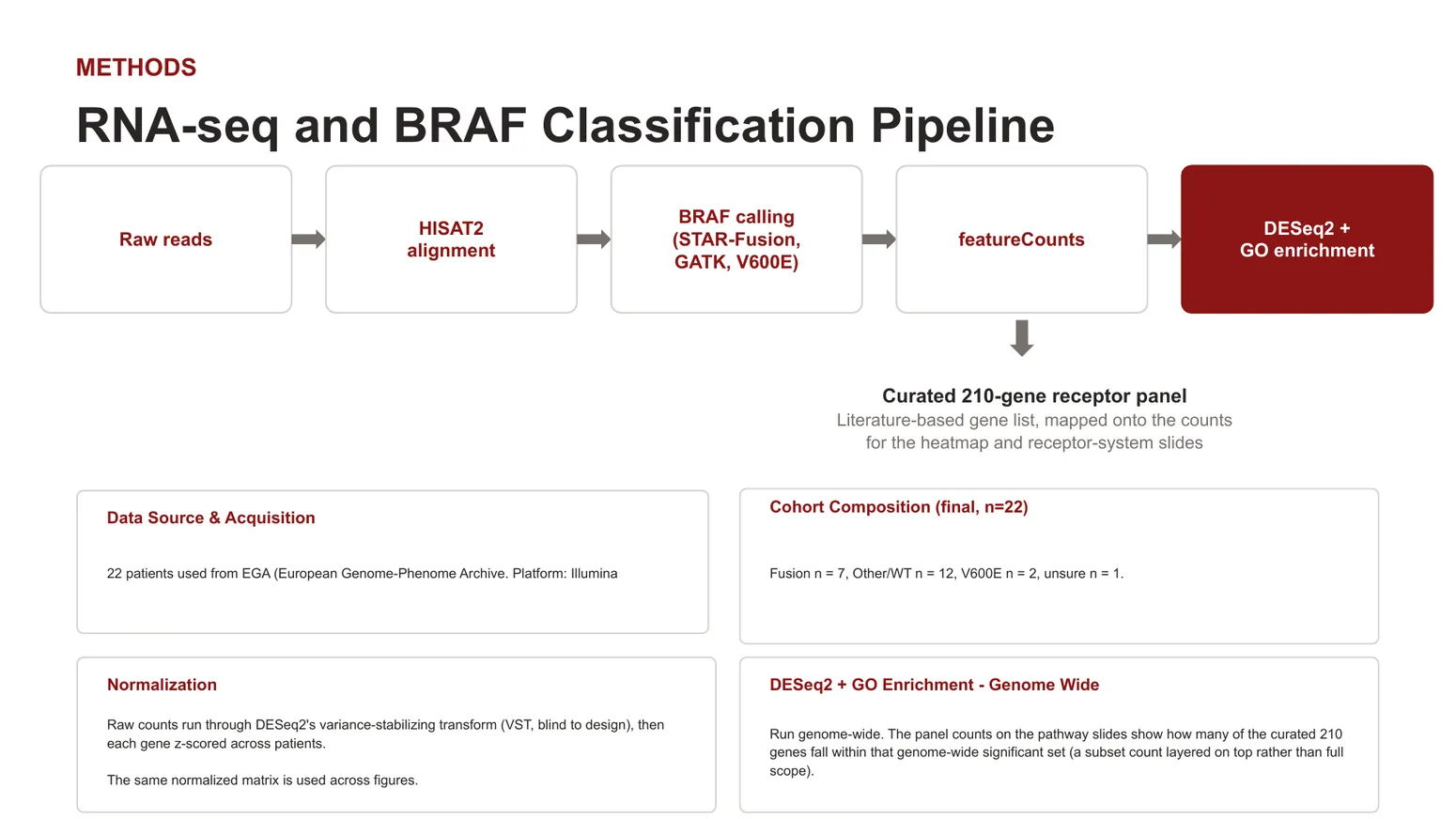
I worked at Stanford with a research group that helped pioneer cancer neuroscience, studying how neural activity influences cancer growth. I built an end-to-end RNA-seq pipeline for 22 pediatric glioma cases, classified BRAF alterations, and profiled 207 receptor and activity-response genes. Unsupervised analysis placed 17 of 19 activity-response genes into one expression block. ADAM10 expression correlated with the activity-response module score (r = 0.64, p = 0.001). I also checked previously classified cases against junction-level fusion evidence. The activity-response signature and BRAF-related differences give researchers new hypotheses about neuron-tumor signaling to test in larger cohorts and cell-specific experiments. They are correlational and are not validated treatment targets.
Gene-expression signaturesAnalysis workflow
Small subgroups, bulk RNA-seq and correlational analysis limit interpretation. Lab figures are subject to public-sharing clearance.
04 / UCSF + VA / UC Irvine
Microbial metabolism, from experiments to analysis.
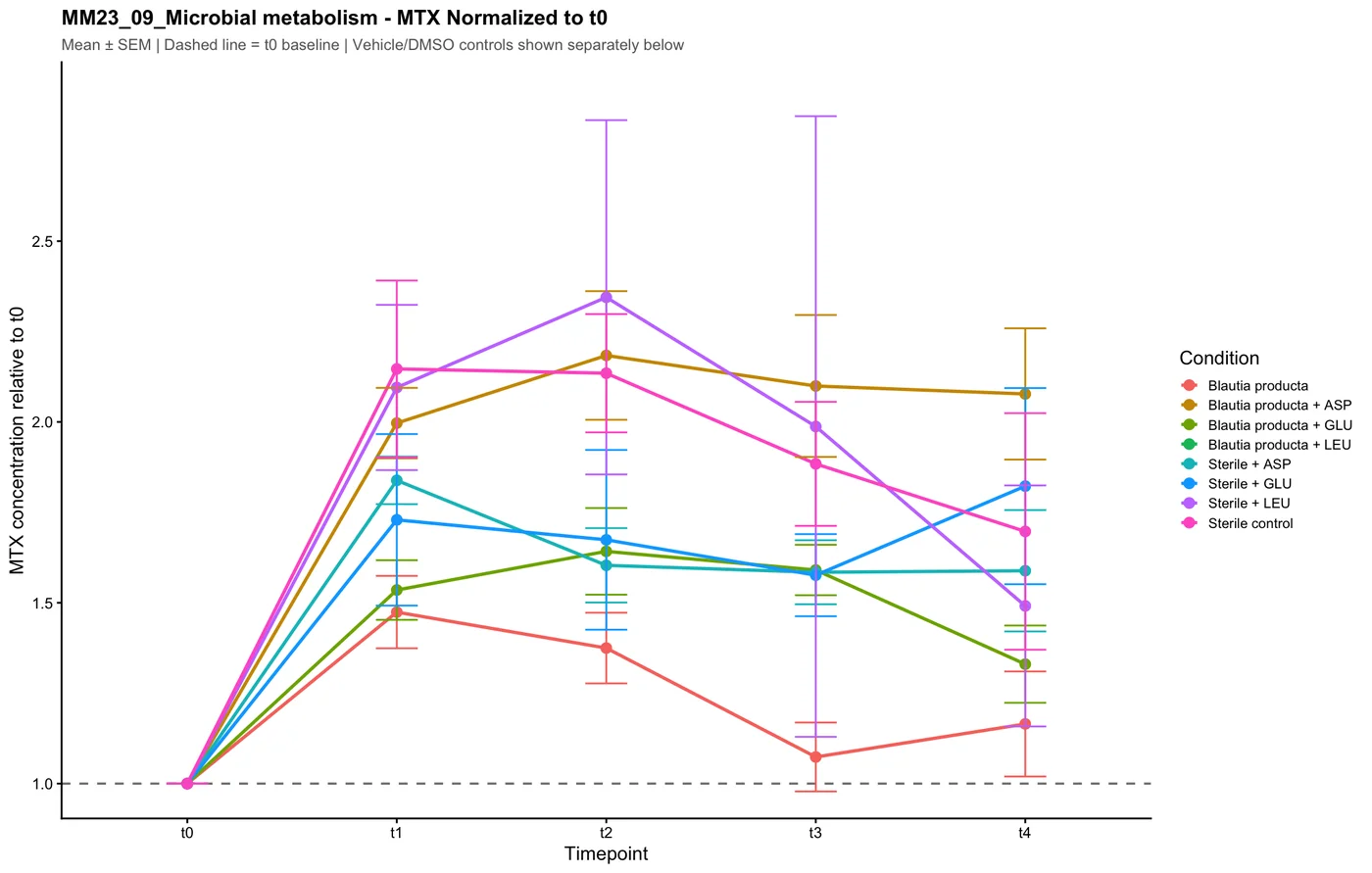
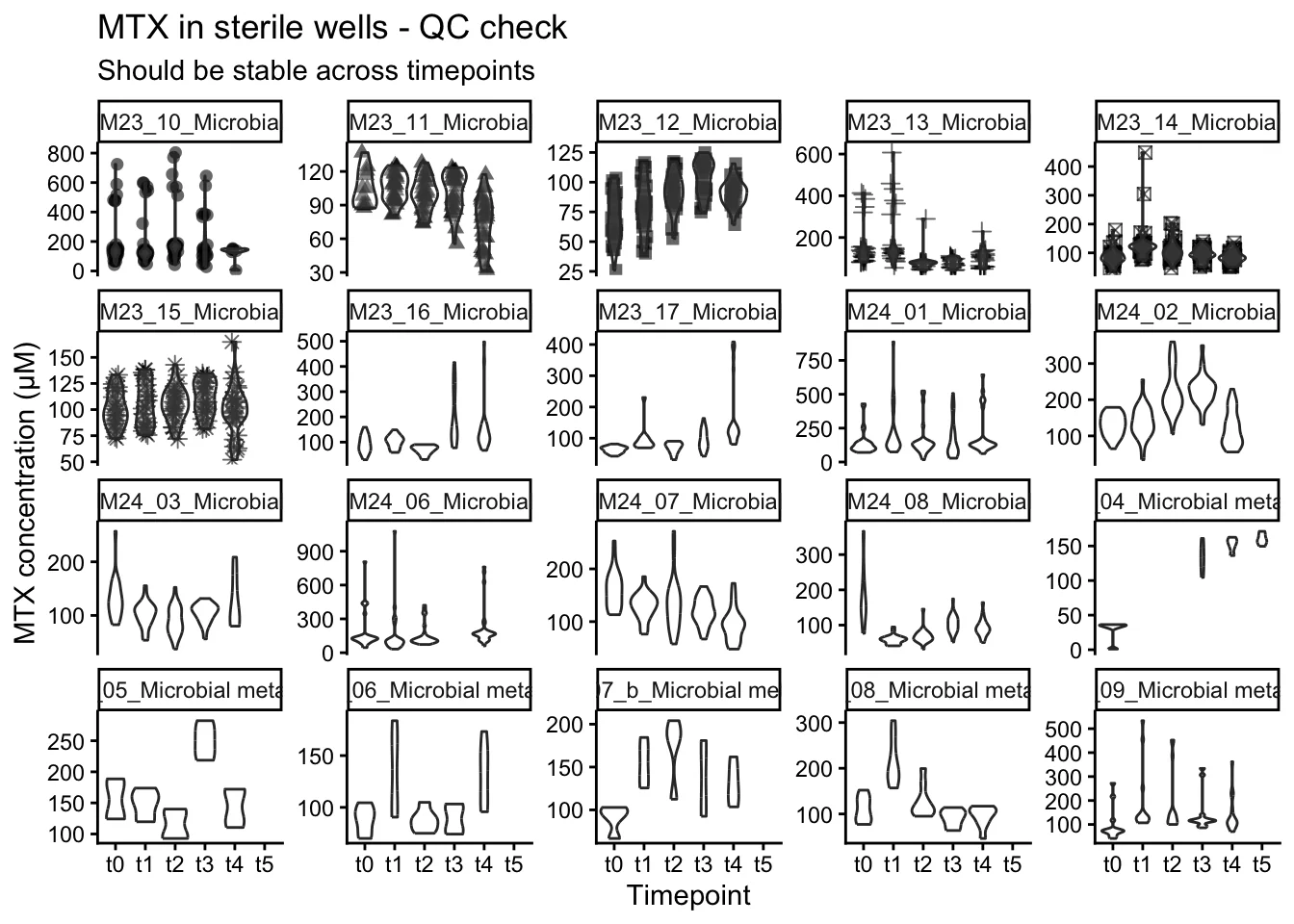
At UCSF and the VA, I developed an R pipeline that reconciled sample identifiers and HPLC results across 19 microbial drug-metabolism experiments. Reviewing the raw chromatography uncovered mislabeled methotrexate peaks, missing measurements, and drifting sterile controls, all issues that could produce misleading biological comparisons. I built checks that surfaced these problems rather than silently smoothing them away. At UC Irvine, I used MATLAB to study microbial growth under different lipid conditions. Together, these projects made me interested in scalable computational tools for studying how microbes affect drug metabolism.
Some apparent differences could be explained by labeling gaps or control drift. Flagging them made the data more trustworthy and identified experiments needing a closer look.
What it could enable
Stronger comparisons of microbial effects on drug concentration, eventually informing research into why a medication behaves differently in different biological settings. Clinical use would need further validation.
Our team proposed an experiment using Earth basalts to evaluate radiation shielding for Mars and presented the concept to scientists at SLAC National Accelerator Laboratory. Our science-outreach proposal received top-15 international recognition among more than 700 entries. I also co-founded a SAGE chapter connecting students with research mentors.