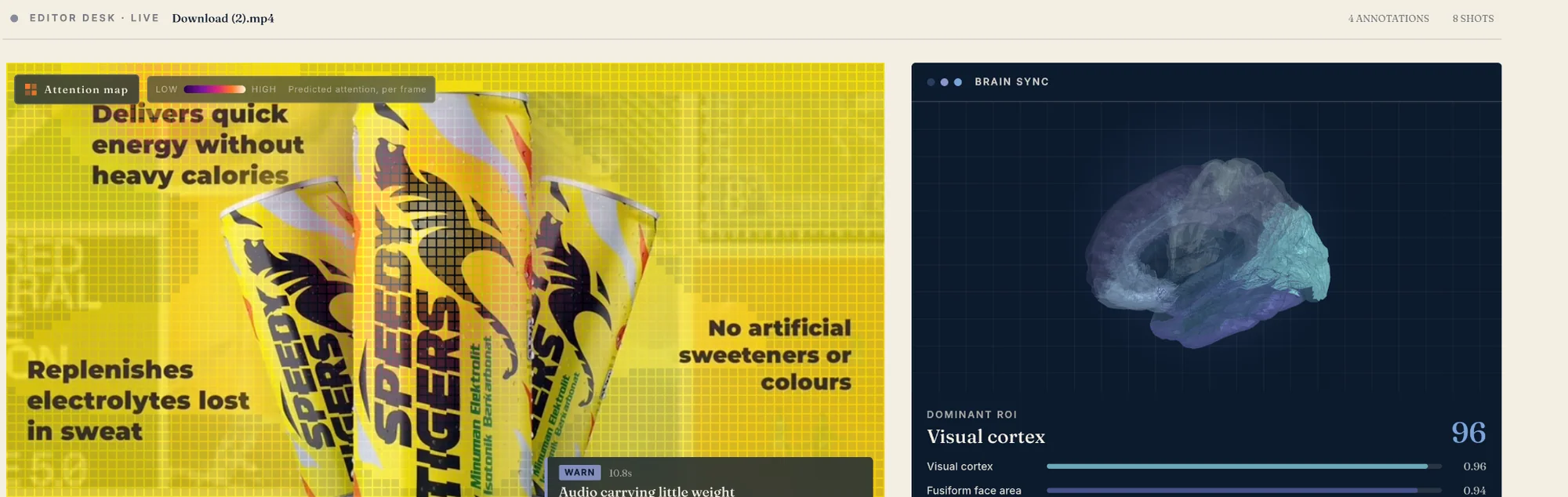
Modeling neural responses for people who create things.
As the first neuroscience researcher at Presonance, I work with our team on models of how people respond to visual, audio and language stimuli. Our work on different sensory experiences has helped shape the next versions of our models.
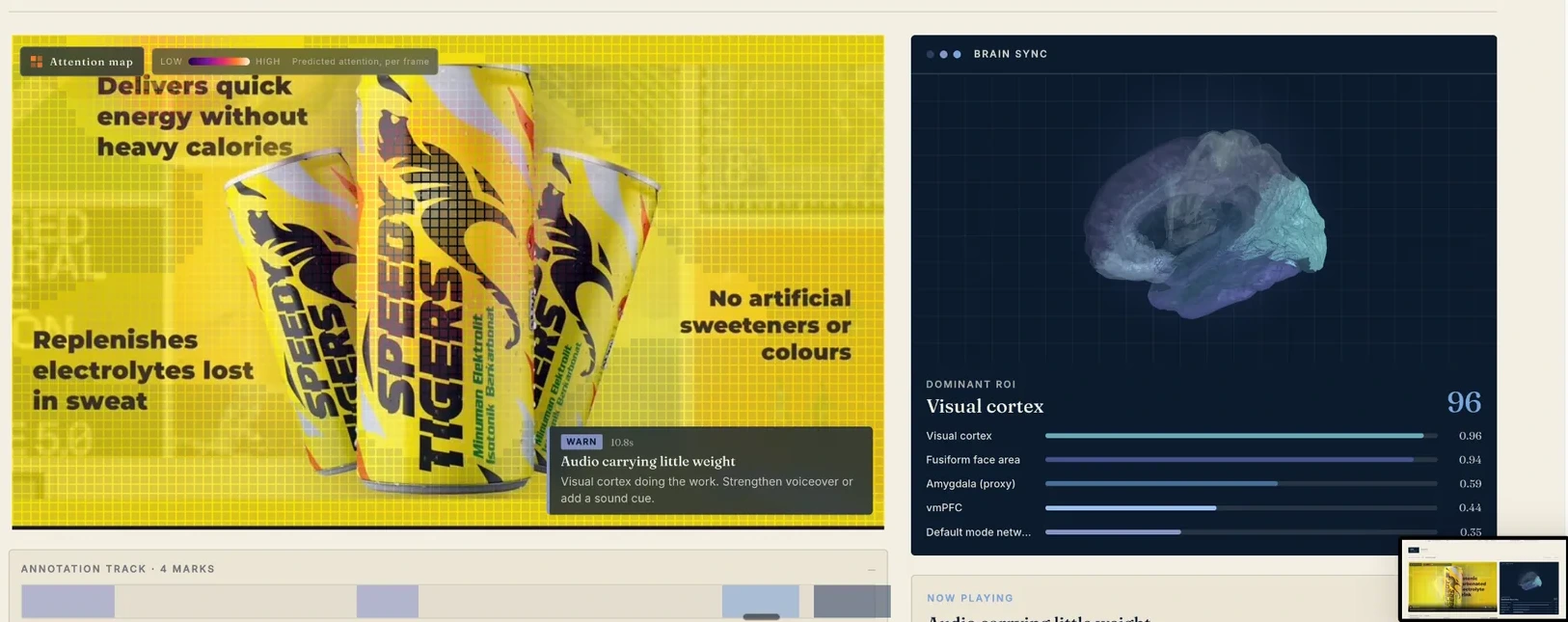
What happens to a representation when the input changes?
I analyzed how cortical representations differ across congenital blindness, congenital deafness, and typical sensory development, using matched film stimuli and contextual language-model features. In related coauthored research, contextual features outperformed static sentence embeddings across all five groups, with 27 of 40 network tests passing FDR correction. I brought this research into our team's evaluation and model-development discussions.
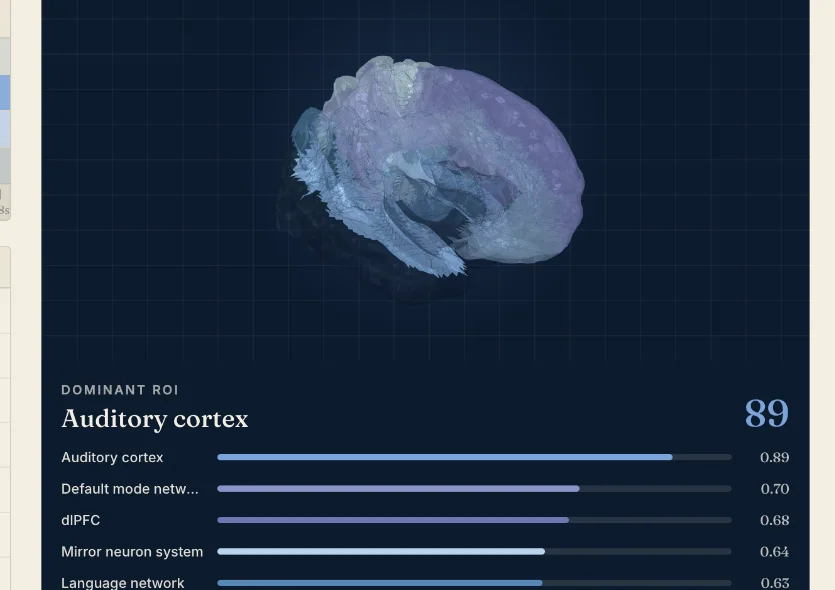
Our internal benchmark outperformed Meta's TRIBE v2.
Our team's reported evaluation scored Presonance at 0.46 against 0.37 for Meta's TRIBE v2 on the comparison we ran. My research on cortical responses across different sensory experiences contributed to the model-development work behind these iterations.
Team-reported internal comparison. Metric definition, evaluation split, and reproducibility details are pending public release; this is not an independently validated general ranking.
One question I keep pursuing is how to make prediction work more reliably across people with different sensory histories and signals.
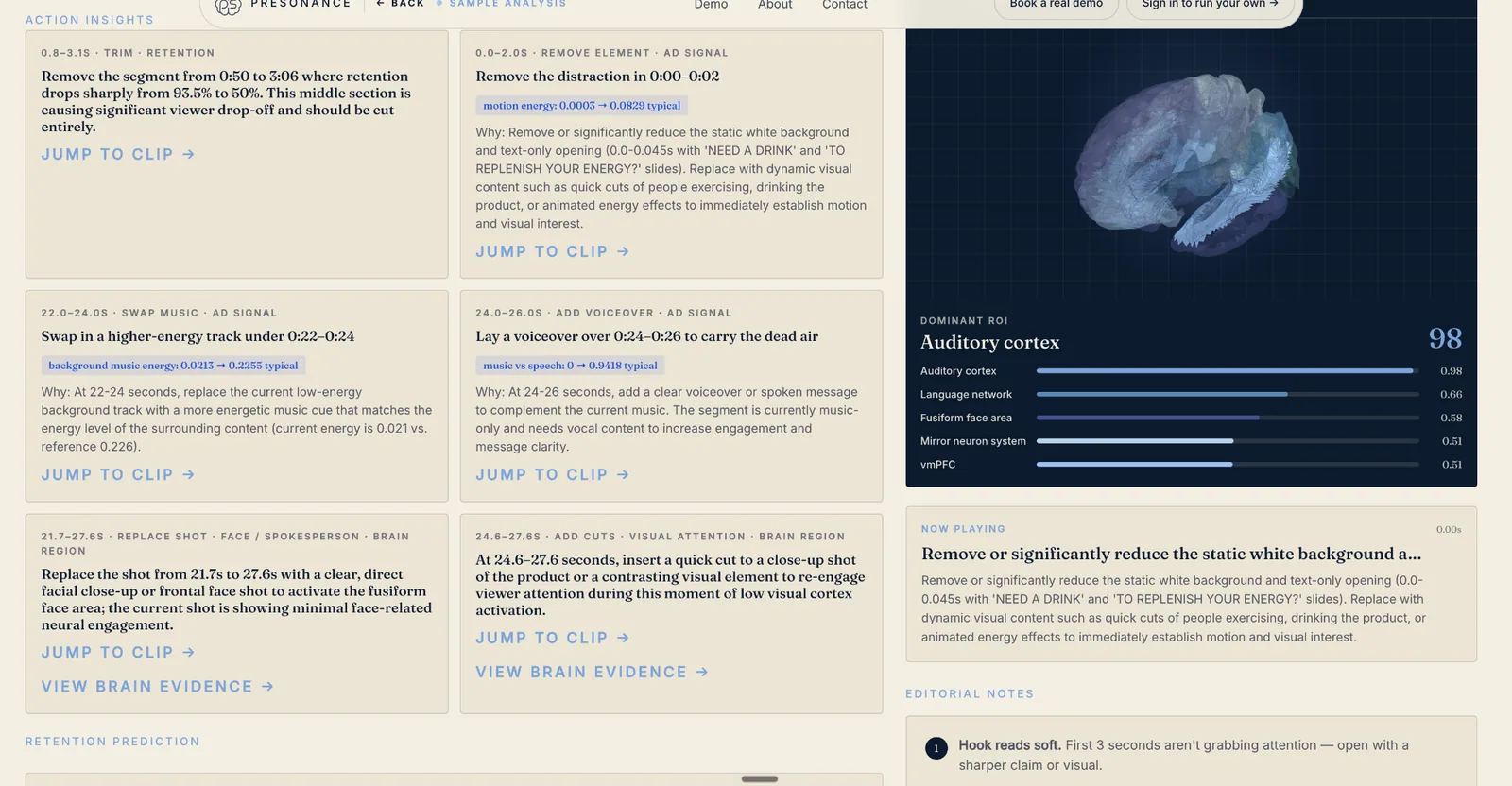
Making the output useful to a creative team.
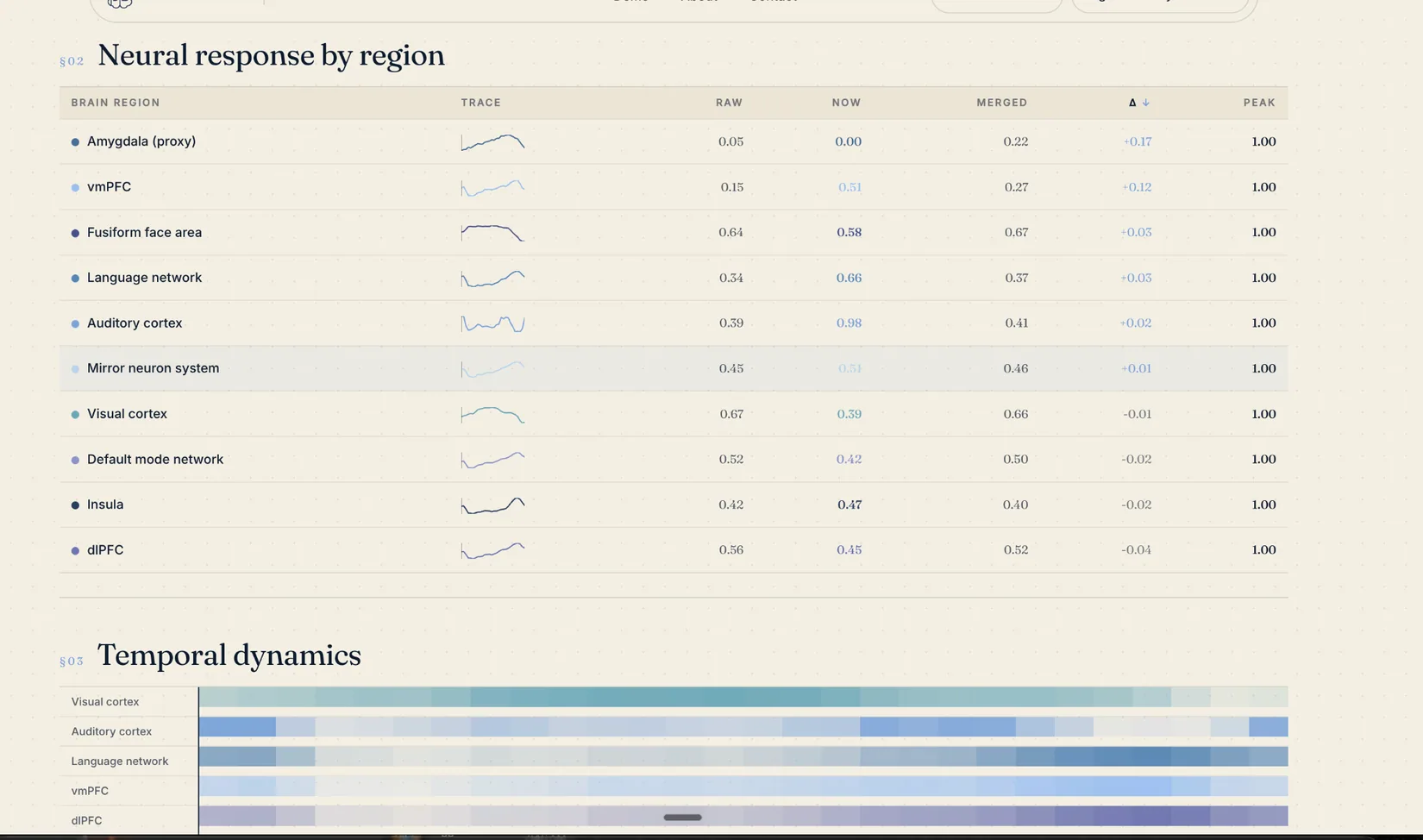
The live editor shows attention changes throughout a video, regional brain-response predictions, and concrete suggestions for how to revise a creative sequence. I also like the storytelling and product side of getting complex research into a format users can understand.